RECREATION CAMPS

A safer place to wait for what comes next.
When the disasters arrived faster than Los Angeles could rebuild, temporary housing became permanent almost overnight.
The county needed somewhere to put people.
Helix Trope had the answer.
Under emergency powers that remain in effect, the county entered into a confidential agreement with Helix Trope to manage a network of Recreation Camps for displaced residents.
The program was designed to provide food, medical care, education, employment, security, and a path toward permanent housing.
It worked.
At least, that's what the numbers say.
Today, an estimated three million people live in Recreation Camps throughout the county.
And almost nobody seems to know when they'll be allowed to leave.
CAMP ALPHA
Camp Alpha was the original and the exception—built at a bankrupt golf resort.
With assistance from the federal government and the U.S. Army, the property was converted into a model emergency community.
Camp Alpha became the Recreation Camp featured in brochures, public presentations, and government announcements.
It has everything:
Comfortable accommodations
Professionally prepared meals
Medical facilities
Recreation areas
Educational programs
Employment opportunities
Modern security
Reliable utilities
Landscaped grounds
It was never intended to be a permanent home.
But that was before permanent homes stopped being available.
THE CAMPS
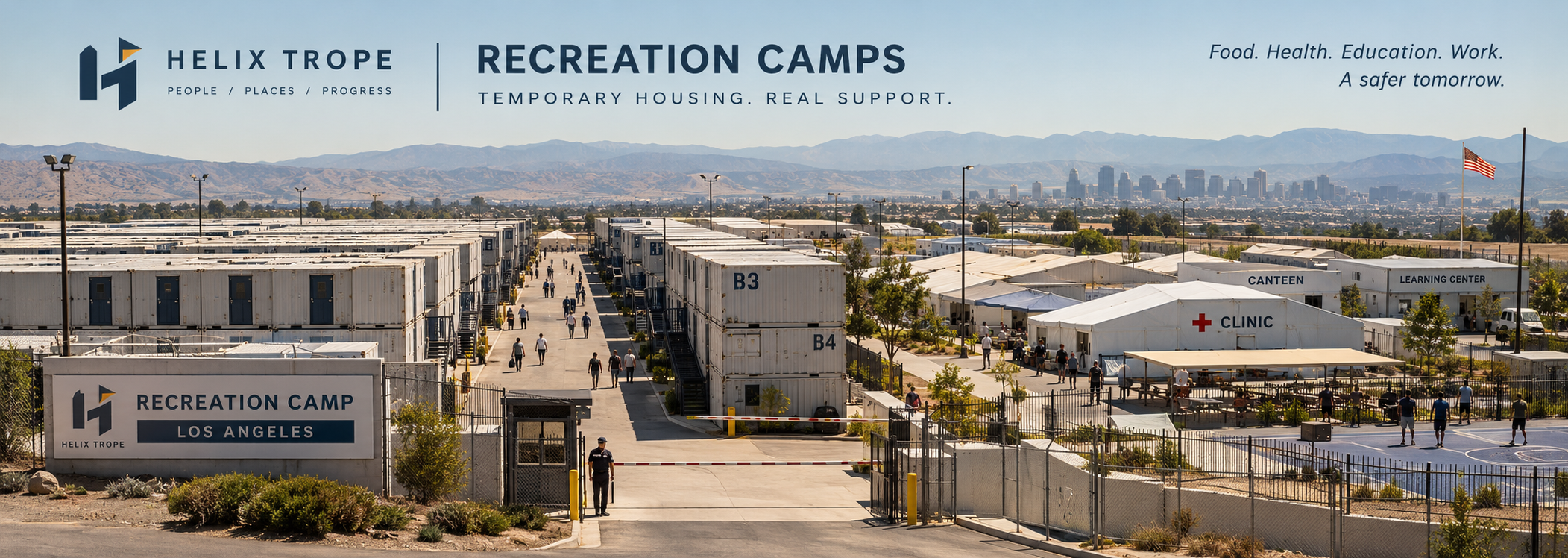
The other camps were built wherever vacant land could be found.
Parking lots.
Industrial and commercial properties.
Former construction sites.
Unused government property.
Wherever there was enough room, Helix Trope could build another camp.
The solution was remarkably simple: shipping containers.
Modified 53-foot high-cube containers became sleeping quarters. Mobile units provided kitchens, clinics, classrooms, administrative offices, and other essential services.
A single container can accommodate 75 people during an eight-hour sleeping shift.
Three shifts allow the same sleeping quarters to accommodate 225 people every twenty-four hours.
The system is efficient.
It has to be.
An acre can hold approximately 82 containers on a single level.
Four levels of containers can provide sleeping capacity for approximately 73,800 people per acre.
Three million people require a lot of space.
Fortunately, the camps don't.
A DAY IN THE CAMP
There is food.
There is medical care.
There is work.
There is education.
There is security.
There is even recreation.
The canteen distributes standardized heat-and-eat meals in biodegradable containers.
The clinic is staffed by qualified medical personnel and equipped with a high-tech multifunction examination and operating table capable of addressing most routine health needs.
The learning center provides job training and continuing education.
Security and support personnel maintain order and assist with camp operations.
Every resident is expected to contribute.
Residents are required to:
· Work in exchange for food and a stipend deposited into a government account.
· Assist other campers and contribute to a positive environment.
· Follow all camp rules and procedures.
· Participate in government and Helix Trope programs.
The system is designed to keep everyone fed, productive, educated, and safe while permanent housing is located.
There is only one problem.
Nobody knows how long that will take.
THE PATH HOME
Recreation Camps are temporary.
That distinction is important.
Camp residency does not guarantee permanent housing.
It does not guarantee access to every camp service.
And residency does not come with a guaranteed release date. It ends only when permanent housing has been located. Until then, the camp is home for the displaced.
Their work remains part of the system.
Their stipend remains in their government account.
Their participation remains mandatory.
The emergency powers that created the Recreation Camp system remain in effect.
So does the contract that allows Helix Trope to manage it.
THREE MILLION PEOPLE
Three million people is a number.
It's easy to read.
It's difficult to imagine.
Three million people waking up in shifts.
Three million people eating standardized meals.
Three million people working jobs assigned through a system they don't control.
Three million people receiving medical care, education, and security from the same organization that manages the place where they live.
Three million people waiting for permanent housing.
And three million people who, technically, are not prisoners.
They work.
They follow the rules.
They can learn.
They can receive medical care.
They can participate in recreation.
They can earn a stipend.
They can wait.
They just can't leave until someone decides where they can go.
WHAT COULD GO WRONG?
The Recreation Camps were created to solve a problem.
Too many disasters.
Too few homes.
Too little time.
The solution was supposed to be temporary.
But temporary systems have a way of becoming permanent when the emergency never ends.
And when the same company provides housing, food, employment, education, security, medical care, and government programs, the question changes.
It is no longer: How do we protect people during a disaster?
It becomes: Who decides when the disaster is over?
Because if the answer is nobody—the camp doesn't have to be a prison.
It only has to be the place you can’t leave.